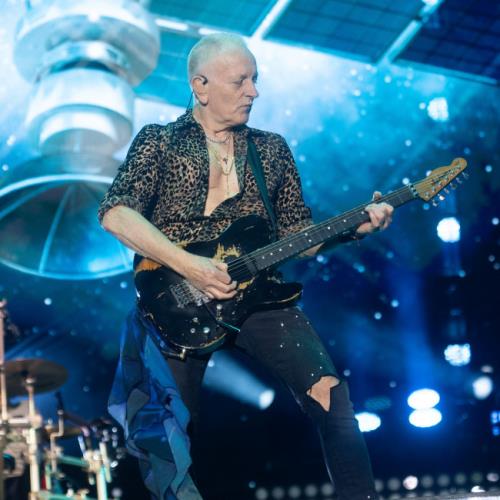
Charley Crockett took the stage at Bear Shadow Music Festival in Highlands, North Carolina, last weekend for a set that didn’t shy away from his missing-in-action album Clovis.
“They took this record down, but I’m going to play one, anyways,” Crockett said onstage before diving into the LP’s opening track, “The Hallelujah Trail.” Clovis was mysteriously removed from streaming platforms early last month shortly after its own surprise release in late April. Crockett’s documentary, A Cowboy in London, also disappeared from YouTube after a short run.
Co-produced by Crockett and Shooter Jennings, Clovis was recorded at Norman Petty Studios in Clovis, New Mexico, earlier this spring. It’s Crockett’s 17th studio album since his debut, A Stolen Jewel, in 2015. It’s also his first independent album since the April release of Age of the Ram, which signaled the last chapter of Crockett’s Sagebrush Trilogy, which he released via Island Records (Universal Music Group).
“I think the music business,” Crockett tells Rolling Stone backstage at Bear Shadow, “a lot of times, tends to treat mules like thoroughbreds and work thoroughbreds like mules if you don’t play their game the way they want you to play it, you know?”
In an Instagram post on Thursday, Crockett said his “street team” would be handing out free CDs of the album during CMA Fest this week in Nashville.
A rep for Island Records did not immediately respond to Rolling Stone‘s request for comment.
Was it your decision to pull Clovis off streaming or was that above you?
That’s above me.
But wasn’t it an independent release?
Well, it’s independent. Self-released it.
So, you’re saying it was against the contract with your former label?
Yeah.
Is Clovis going to come out again?
I sure hope so. I’m gonna get it out. You know, I turned down every deal I got for seven or eight years, and the Universal system offered me deals in a variety of formations before it landed with Island. What I’ll say is, I’m really proud of the three records I made with them. And they didn’t have any kind of say or anything over those albums. I just turned them in and we put ’em out. And I don’t think they expected me to put records out that quickly. They have their system, and their system is these kind of two-year record cycles… It took ’em like three years before I was willing to sign a deal. And the reason I eventually relented was because Island gave me creative and release control. I’m not sure they thought that I would ever actually exercise that control.
Are you still under the contract?
I’m out now.
So, then why are they going after you?
Well, it’s complicated.
A lot of red tape with lawyers?
Yeah. It’s all right.
A lot of cooks in the kitchen?
Yeah. I’m proud of the albums. I really am. You know, I had a manager at the time [and] I wasn’t really involved and able to have the conversations that I would’ve liked to have been having in those negotiations. And then I really dealt with a lot of people kind of trying to swoop in when “Super Manager X” was out of the picture. I really dealt with a flood of people trying to come in and get the business.
I mean, I can’t point to Universal and say these guys did me wrong and all this kinda stuff. I just found out that their system is what I thought it was. And I think maybe what they thought was gonna happen with me based on the business people around me, I think they had a much different idea of maybe how I would play their game.
So, moving forward, would you want to sign with another label or keep it independent?
I put out 14 records with Thirty Tigers, and they call that independent. But it’s Sony Orchard that distributes it. That’s not truly independent. No one’s truly independent if you’re being distributed by any of the majors. And if you’re not being distributed by part of the major label system, you’re not really on the map. You see, that was always kind of my struggle with being somebody that maybe wasn’t easily classifiable or easily marketable in, say, like the Americana machine. And I’m grateful for Americana, because who knows how I would’ve ever shown up on the map. But I have said over and over in the last five, seven years, that part of the struggle of the Americana machine is it behaves just like the major label machine, just with less money.
Smaller gatekeepers.
Yeah. But they were very apprehensive about my release strategy within the Americana world, that [it] was abrasive and I broke that. I broke that cycle, kind of going against [that].
Does that play into the same reason why the documentary got pulled?
They’re related.
I got to watch it before it got pulled.
You see it on YouTube?
I did. What I loved about it was [that] it showed perspective. When you were there, you were reminiscing about the old days when you were busking and nobody was around, and then you were present for the fact that you were selling out shows in London, and then you went over to Royal Albert Hall looking to the future.
Yeah. We didn’t know what it was gonna be. [Director] Jared Christopher and I, what we’ve been working on for over two years, getting closer to three years now, is this movie that I asked him to make with me, that I put up the money for myself, that’s kind of a mixture of narrative and documentary. My goal in the beginning, somewhat naively, was that I was gonna get this movie made in six weeks and get it out with [the 2024 album] $10 Cowboy.
The gears of moviemaking move slower than the gears of recording records. And also, man, I don’t think anybody around me besides Jared and myself, business-wise, had any faith or real interest in helping us really achieve that and following through. Jared asked if he could go over to England with me and the manager I had at the time. What they were really doing, which has been happening a lot since, [is] bigger business people have gotten in. I started touring over in Europe when I was getting paid nothing, right? With no agent in Europe all the way back in 2017. I managed to go over there, take my whole band, do full band shows for many years. Soon as the bigger business interests were going in…. they’re telling me I can’t afford to go to Europe. And it’s, “Go over there and play solo. Let’s just go do press stuff.” It’s just corporate bureaucracy.
I went back and rewatched the end of tour reflections documentary with you and Leon Bridges from October 2025, and wrote down two quotes you said: “Resist a rising tide of conformity” and “I’ve spent a lot time devoting my energy to defending my art.” How does that play into where you’re at right now?
That’s all you gotta know, really. The further you get out there into the public eye, the more pressure there is to conform to the interests of the business around you. It really is a Coke and Pepsi world. And when you get on the map and you’re cutting into their money, they show up to buy you out. And if you don’t accept the buyout, they turn their interest to putting you out of business. And if people don’t realize that, it’s because they’ve never had the Coke and Pepsi interests of the world come knock on their door.
Does that fuel you or put a bitter taste in your mouth?
It’s both. It’s hard. There’s this quote from this Butch Cassidy and the Sundance Kid flick. There’s this line where it’s [Paul] Newman playing Butch Cassidy, and the big corporate railroad interests that are hiring out the bounty hunters, if you will, to put Butch and Sundance out of business. Newman says, “If he’d just pay me what he’s spending to make me stop robbing him, I’d stop robbing him.” I’ve seen a lot in my life. And the one place that I draw strength from is I don’t feel that these people can put me in jail. I also don’t think they can take away my birthday.