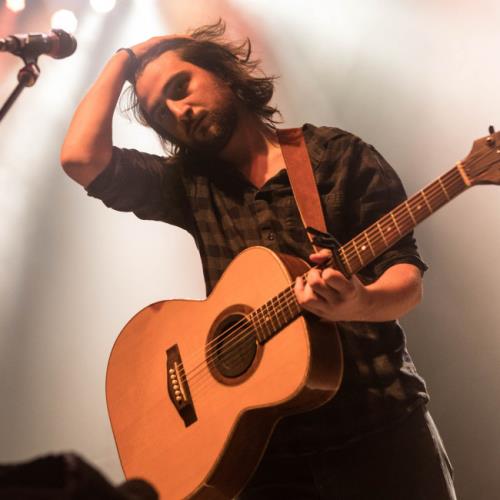
Orville Peck thinks often about what would have happened if he died that night in 2023 of a self-inflicted overdose, heartbroken and hopeless at his New York City hotel. It was the evening before he was supposed to play to a sold-out crowd at the Theater at Madison Square Garden, kicking off his Bronco run with one of his biggest concerts yet. His team found him the next morning and issued an ultimatum: get clean, or he’d be on his own.
But the show had to go on. Peck put on his fringe, leather, and mask, and powered through a dynamic 19-song set as if nothing in the world was awry. Then he canceled his tour, packed his bags, and checked into rehab.
“I was in one of the worst places in my life, for sure,” Peck says, seated in the stars and stripes-themed dressing room backstage at the Grand Ole Opry, where he’ll be making his Opry debut in a few hours. He’s in a pair of ripped jeans and a ringer tee, his signature mask now just a wisp of tan leather, the rest of his face in view. “I was a bad addict, a coping alcoholic. And I had this spiral moment, where I went back to my hotel and tried to take my life. It was a big turning point for me, with a lot of realizations to come. It was something that needed to happen.”
His forthcoming album, Mule, begins with this moment of darkness. Namely, with a trio of his most beloved influences and collaborators — Emmylou Harris, Allison Russell, and Noah Cyrus, “the three witches of Macbeth of my country music story,” as he puts it — singing a bluegrass hymn that imagines what would have happened had Peck never woke up that morning in New York. Out Sept. 18th, Mule tells a chronological story of the worst year of Peck’s life, when he broke up with his partner, succumbed to the depths of addiction, went to rehab, got sober, and faced a reckoning with both the public and private versions of himself: not the masks he wears as costume, but the ones we all use to cope and frame how we appear to the world.
Since his debut album Pony was released in 2019, Peck has always trafficked in a perfect alchemy of mystery and intimacy. For someone who performs in a mask and had often relied on metaphor to guide his lyrical decisions, his connection with his fans is unusually close. Tattoos of Peck’s fringed face are common, because he represents a certain kind of outsider, a superhero of a gatekept country music industry where he avenges for justice, a reframing of the cowboy for other queer kids and misfits who didn’t see themselves in the genre they loved. He doesn’t traffic well in the confines of fame, so “Orville Peck” is a stage name that heightens the mystique — but, then again, so is Shania Twain, Lana Del Rey, and Bruno Mars. On Mule, he’s learning how to reconcile both parts of the man he is, or maybe make peace with the fact that he’s always going to be a bit splintered. And that’s OK.
He’s never written more candidly. “I think I have learned that whenever I shy away from telling the truth about whatever I am going through in my music, or whenever I’ve been hesitant to really go there, I’m always a little bit disappointed with the product, and I feel like I’m cheating myself a bit,” Peck says. “What I was really trying to capture in terms of the concept, there was no way to gloss over or sugarcoat it.”
It makes for his best, most realized, album yet. With his bluegrass chorus of Harris, Russell, and Cyrus woven through moments of classic country, glam-pop, and glossy SoCal cowpunk, Peck lays it all out: the breakup that tore him apart, the nights spent in his Los Angeles home alone, sleeping around to dull the pain (“Big Ole House”), the overdose, the trip to rehab (“Rehab Blues”), the wrestle with fame and identity that he’s still working through (“Cowboy Heart”). He even drops a little tea: namely, an affair with a member of a professional sports team on the swinging “Ring the Bell.” “I love the Lakers, the Mets and the Longhorns, made out with a guy on the Raiders,” he sings, combining twang, melancholia, and some hearty gossip in the way that only Peck can.
It’s all as funny as it is achingly sad, but Peck knows that even in our most miserable times there’s sometimes a comic moment to be had. He loves a country hokum song, where wit and humor help mask (or unmask) deeper themes. Peck’s hokum here is “Rehab Blues,” a whistling ditty about one of the hardest months of his life. “So catch me on the evening news,” he sings, his emotion becoming more audible with every word despite the punchy melody, “dumb fag dies from the rehab blues.”
“I think as a sensitive artist, the impulse would be to write a really sad, heavy song about being in rehab,” Peck says. “But the reality is, I didn’t want to be there. I thought it was a waste of time, that I’m unique and didn’t have a problem. So I was like, I’m going to write the funniest song about this experience, because at the time I was just like, ‘Fuck this. I want to leave.’”
The first single, “Too Little, Too Late,” lives in a similar lane. It’s a rowdy, “indie sleaze” anthem about the kind of freedom that only comes after a lot of hard work. As it turns out, Peck is really, really great at rock & roll, too. Growing up in South Africa, it was his older brothers who turned him on to punk music. But he really found his stride when he discovered country and Johnny Cash. (“Shot a man in Reno/just to watch him die” was more punk than punk.)
It all made him the mule he is. “A person between two worlds, not really knowing where I belong or where I need to live,” Peck explains. Peck’s albums have always been named after equine themes: Pony, Bronco, Stampede. He likes to keep his work all part of one growing, moving body as much as he likes to make people toy with who they think gets to claim the idea of a cowboy riding those horses. A mule, though, is different from a glossy thoroughbred, and the title track, which closes the album, finds Peck settling into who he is with all the discomfort that comes along, singing through emotional cracks in his voice.
Intermingling identities is something he works through on the second half of the album — the idea of being “Orville Peck” the celebrity, the character, and the person when the stage lights are off. He’s leery about how much he talks (or complains) about fame — champagne problems, he realizes. But Mule, and Peck’s concerns, aren’t just limited to those in the spotlight, because none of us are who we seem on the outside. Sometimes we’re famous, sometimes we’re in costume, sometimes we’re presenting an image on social media that isn’t anywhere near who we really are. These days, everyone’s splintered into parts and performance.
“It’s the irony of how ten years ago, I decided to put on this mask,” Peck says. A decade ago, that mask covered his whole face with fringe that sometimes dripped several feet down; over the years, it’s shrunk to the one he wears now, small enough so it almost disappears. “Little did I know that would be the decision that would reveal the most about me. Not to get too corny about it, but we all wear masks, and we all present how we talk, how we act, how we come across. Whether that’s at work or around friends or certain people. And when you get home, no matter who you are, you have to go sit with yourself.”
Appearing as the emcee to raves on Broadway in Cabaret helped Peck on this journey, where he wore a different kind of mask: the white and black stage makeup of a character in a story where artists and misfits create their own insular world. For Peck’s fans, many who never saw themselves within country music, his music has been that entry point.
“I think a lot of people assume pretty narrow views of what country music is,” Peck says. “I guess it takes something very against the grain to open things up for people. But I didn’t ever really consider that there would be this sort of club or industry to try and infiltrate or earn the respect of. I didn’t think about it that way. I just wanted to make country music and tell my stories.”
Peck’s love for classic country is deep, especially for its legends and institutions. Later, during his Opry debut, Peck will sing “I Will Always Love You” by his icon, Dolly Parton. His top three goals, he says, were to duet with Willie Nelson (check), play the Opry (check), and perform with Parton (not yet, but feels well within his grasp). Tonight, he’ll be part of a lineup featuring friends, collaborators, and fellow outlaws who have also fought to make country a more inclusive kind of space: Kaitlin Butts, Margo Price, Mickey Guyton, Dasha, Cleto Cordero. Peck’s thrilled that music from women and queer artists is starting to become more mainstream against just “straight white men singing about whiskey in a truck.”
It’s time for soundcheck, and Peck needs to change into his tan Nudie-style shirt and pants, an ensemble that would’ve made Porter Wagoner smile. “I think I’ve proven, most of all to myself, that I belong here,” he says. “I thrive in this community and industry. Just being a weird little gay boy from South Africa, I think I’ve done pretty good.”