
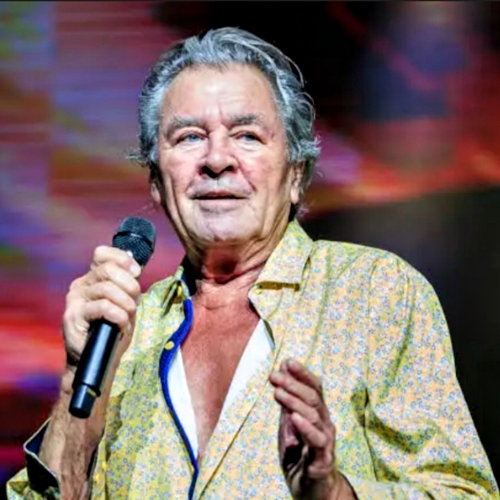
‘In the previous band, Episode Six, we had a girl singer, Sheila, and in every set she used to come out front and sing two or three songs, and I would go to the keyboards where she was and I’d play – badly – some organ. But the thing is I’d replaced the female voice in the band with my very high voice. And so that came naturally to me, so when we were doing Deep Purple, I wasn’t limited by the normal range scale, I just kept going up and it was the age of discovery, but it was as much of a surprise to me as everyone else.’
He also chats about his upcoming single recorded with unsigned band UROCK, gives us a sneak peek at next year’s Deep Purple World Tour, let’s us in on his future plans for the band and tells the story of his most embarrassing on-stage
A Side.
?You’ve done something really exciting. You’ve teamed up with an unsigned band, an independent band for a single called The Line. Can you tell me how this came about?
It’s a combination of circumstances. I first met Umberto, who’s my connection with the band mainly, at their radio station in Rome. And he lives in Portugal and we kind of hooked up for an interview and things developed from there. And they had a record and he said, ‘would you have a listen to it?’ And then he said, ‘would you have a sing on it?’ And then I did. I liked the song and I liked the guys. And it was just a very organic development.
And other than UROCK, what other music are you into? What are you excited about at the moment?
My current listening at the moment is African music and 1920s/30s jazz. Django Reinhardt and Art Tatum, people like that. Absolutely joyful performances, so I’m very much into that.
How does making music and performing compare now to 30, 40 years ago for you? Is there a big difference?
There is. There’s a big difference in lifestyle. I mean, everything changes in phases throughout your life. I mean, you start off writing songs about fast cars and parties and loose women and things like that. And then you get to the point where you’re in your late thirties and you think, hang on, my voice is changing again. I’m physically changing again, but also mentally. And you think, ‘that all sounds a bit embarrassing now for a mature guy to be singing about the same old things.’ But the challenge is you still gotta write exciting stuff but it’s gotta be convincing. So if you are prepared to do that, then you can step into the next phase of your life. When I was a kid, I used to be an athlete. I used to do pole vault and javelin, they were my two sports. I played football and cricket and did a lot of physical things. And I can’t do those anymore. Can’t do the pole vault anymore. So yeah, things do change. I used to, like everyone else, party all night. But your capacity for doing those things is not necessarily greater. You just don’t notice how it’s affecting you. So you just plug on through because you’ve got this – your strength is, your core strength, is accelerating. But then it starts diminishing, and so you have to take care of yourself a bit more. I don’t drink at all when I’m on tour now, I save it all up for when I get a couple of months off at home. Then I enjoy it very much. So I lead a much healthier life now according to other people, according to my medical people, but they don’t see me when I’m off duty!
B Side.
Who influenced you musically when you first started out?
Oh, it was a lot of things. I came from a musical family. My grandad sang opera. He had a fantastic bass-baritone voice. My Uncle Ivar was a jazz pianist, played ‘Boogie Woogie’, and I was a boy soprano in the church choir. And then I got into rock and roll in about ’54. I heard Heartbreak Hotel and that kind of influenced me to start my first band. And there have been many influences along the road, but they were the main ones to start with.
And when did you discover, hang on, I’ve got a really good rock voice here?
I didn’t. Not for years because with my first band I was singing blues, and rhythm & blues and we went from the Delta stuff right up to Chuck Berry. That was my first band in ’62 to ’64. In 65, I joined a band called Episode Six and that was a harmony band. We played all kinds of stuff and I loved harmony music from my choir days, but that wasn’t really what you might call rock as we know it. That was more kind of across the board stuff. We would play anything that had harmonies on it. That we had six voices in the band. They sounded great. It wasn’t a strong instrumental band but vocally, it was very powerful. But it wasn’t until ’69 that I joined Deep Purple with Roger Glover, and we joined as a bass player and singer, but also as a songwriting unit ’cause we’d started writing a couple of years before and it was serendipitous. Perfect timing. So then I got stretched out ’cause I was working with people like John Lord and Richie Blackmore and Ian Pace, and we were on the cusp of something new. They’d been developing their ideas for a couple of years with three albums prior to that. And then it all kind of came together and we started something fresh and they called it “Hard Rock”. So that’s when I – and I wouldn’t say it’s a discovery because it’s funny how the little things come together. In the previous band, Episode Six, we had a girl singer, Sheila, and in every set she used to come out front and sing two or three songs, and I would go to the keyboards where she was and I’d play – badly – some organ. But the thing is I’d replaced the female voice in the band with my very high voice. And so that came naturally to me, so when we were doing Deep Purple, I wasn’t limited by the normal range scale, I just kept going up and it was the age of discovery, but it was as much of a surprise to me as everyone else.
Yeah, I mean, it, it turned out to be a winning formula. I mean, it was just brilliant, wasn’t it? And as you say, it was all new at the time, so very exciting.
Bonus Tracks.
What was the first song that you ever loved?
Well, it was Heartbreak Hotel by Elvis Presley. I think it was 1954, something like that.
Do you have any favourite venues you performed at?
I’ve got great memories of the early days, of course, because they stay with you forever. And as you increase your pace of touring and as you increase the intensity of the touring – for example, next year, I’ve been told to pack my bags in April and I’ll get home in November. So that’s pretty much how dense the concerts are these days and they all merge into one, to be honest. But you remember the same venues from back the first time you played them. For example, the Marquee in London, the Royal Albert Hall was very big. The Concertgebouw in Amsterdam, which was a funny story actually because there was a little bar way back up in the gods of the theatre. And I went there for a drink. I wasn’t feeling too great. I had a bit of a chest and so I ordered a scotch and coke before going on and I couldn’t hear the band up there it was so remote from the theatre and somebody came and said the band had already started without me. And so they rushed me through and they found this door at the top of a great staircase that led straight down to the stage. And I thought I’d make my entrance from there. So I did, and I was wearing a pair of trousers that were a bit too long and I caught them in my heel and I fell at the top of the stairs holding a big goblet of scotch and coke. I did probably three complete somersaults, if you can do somersaults along the ground or down steps, you know what I mean? It wasn’t through the air. And I landed sprawled across the bottom step on the stage. But the remarkable thing was I hadn’t spilled a drop from my drink I was still holding in my hand. That was quite an entrance.
That is one heck of an entrance. Amazing. And what’s the hardest song you’ve ever sung?
The hardest song I have ever had to write and sing is called Never a Word. It was on a deep purple album called Bananas and it was very difficult. There are lots of difficult songs to sing with Deep Purple because they’re such fine musicians. They sometimes get lost in difficult time signatures and stuff like that, and chord progressions that sound fantastic, instrumentally. But when you’ve gotta write a song over it and keep interest with lyrics and stuff like that, it’s very challenging. But that, I think, is probably the hardest song I’ve ever had to sing.
What do you think is the greatest Rock album from the 60s/70s/80s? That huge rock era?
For me, it would be Pet Sounds, the Beach Boys. Absolutely amazing record. Incredible. I don’t listen to a lot of rock music after a while because I sing a lot and I write a lot of it, but when I’m listening, I like to listen to other stuff.
And what can we look forward to next with you? Can you give us any insights or anything that’s coming up?
Well, there’s a lot of material being written and whatever, but there’s nothing scheduled for release at the moment with Deep Purple. I’ve got a backlog of books and records and stuff that, if I get a break, possibly in a couple of years time, I’ll be able to deal with that. There’s a big deep purple tour next year, another humongous tour, as I mentioned, starting in April, finishing in November. I don’t have a schedule yet but I know it’s the four corners of the earth.
That’s gonna be epic and we look forward to the new single as well with UROCK.
Listen to all episodes of The Leona Graham Podcast which are available to stream now free on Spotify, Apple Podcasts and YouTube.


